The job did not exist so she built one that combines art, science and education
What happens when the career that fits you does not exist yet?
Dr Sue Pillans did not leave science behind. She combined marine science, art, education and storytelling into work that finally made sense. That's career architecture at its best.
The job did not exist.
So she built one that combines art, science and education.
The serious career box
Most people think they have to choose between science and creativity, stability and freedom, career and lifestyle.
Dr Sue Pillans refused to accept that split.
Sue started her career the way many STEM professionals do, with a PhD, hers in marine science, then built a career through roles across government, university and research organisations. It was a path that made complete sense on paper, and was all very fulfilling, at least for a while.
She had done the serious thing. The sensible thing. The path people understand at dinner parties without needing a diagram, which is slightly ironic considering what came next.
But like many STEM professionals, Sue reached a time in her life where something was off, some pieces were missing.
"I wasn't really happy in, in my work after a number of years and sort of was feeling a bit, there's gotta be something else out there, I'm not really sure."
That sentence is so familiar because it is not dramatic. It is not a grand breakdown. It is the quiet discomfort many people carry for years while everything looks fine from the outside.
The work is respectable. The career makes sense. The LinkedIn profile behaves itself.
But inside, another question keeps tapping on the glass.
Is this it? Or like book author Rachel Service would say, "There has to be more than this."
For Sue, the answer was yes. There is more than this.
It took a life-changing event to shake her out of "thinking about it" and into taking the steps that would align her career to her true and full self. What I like to call her patchwork.
But the next step was not obvious, because the work she would eventually build did not really exist in a neat category.
That is often the problem for people who feel boxed into a serious career. They are not necessarily lost. They are often trying to find themselves inside roles that are too narrow.
The clues were already there
Sue had always been creative.
As a child, she drew pictures and wrote little stories about cleaning up the world. Later, during her PhD, she found herself needing an outlet and started watercolour classes. She went once a week for five or six years, learning alongside what she describes as a "wonderful teacher".
At the time, it probably looked like a side interest. A hobby. A nice break. Something creative to balance the serious science work.
But those interests were not random. They were clues.
Her art teacher saw it before Sue had fully put the pieces together. Sue would come to class and tell stories about marine science, tagging sharks, pulling nets, catching crabs and learning about ocean species. Eventually, her teacher asked a simple question: why not write children's books about the ocean and illustrate them yourself?
It sounds obvious in hindsight, which is one of life's annoying little tricks.
Marine science. Storytelling. Watercolour. Environmental education. Children's books.
Of course.
But careers rarely look coherent while you are living them. They look like a mess of interests, skills, jobs, experiments, side projects, half-formed ideas and things you keep doing even when nobody is paying you for them.
We are very good at making our CVs look linear. Life, on the other hand, is usually more like a drawer full of different fabric pieces. You collect many beautiful or oddly shaped pieces and it eventually connects into a beautiful patchwork. But not before you question your entire system and start looking at how to arrange the pieces together intentionally.
Sue's story is not about suddenly becoming creative. She already was.
It is about finally letting the creative part of her sit at the same table as the scientist, the educator, the communicator and the person who loved the ocean.
When life changes the question
The shift did not come from a five-year plan. It came from grief.
Sue's younger sister was diagnosed with cancer around Christmas and died three months later, shortly after her 35th birthday. Watching someone young and active fight for her life changed Sue's relationship with risk.
"So I stuck my job out a little bit longer. Then I went, no, life is too short for me to come to work each day and not be happy in the work that I'm doing."
There are moments when life makes the question painfully simple.
Not easy. Simple.
What are you doing with the time you have?
That kind of clarity is not tidy. It is not the kind you can schedule for 9 am after coffee. It often arrives unwanted, inconvenient and completely rude.
But it can cut through the noise.
Sue left her government role with some financial support through a redundancy package.
Then one weekend, she read an article in a creative magazine about visual thinking and visual storytelling. She saw a woman who listened to people's stories and turned complex ideas into drawings.
Sue saw a job she had not known existed.
And something clicked.
"I was reading one weekend this magazine, about this visual thinking and visual storytelling. And I, and at that moment I made that decision and I went, quit my job, went and did a course for three hours in Melbourne about visual visualizing things. And I started my business the next day."
This is the part of the story that sounds impulsive. And in one sense, it was.
But it was not random.
That moment landed because Sue already had the ingredients. She had the science. She had the communication background. She had the government and university experience. She had stakeholder engagement, policy, planning and research program experience. She had the art practice. She had the love of nature. She had the desire to make complex ideas easier to understand.
The magazine article did not create the path, it gave her a frame.
Scary is not always dangerous
Sue describes herself as someone who had been risk averse. She liked lists. She valued security. She was used to roles with holiday pay, sick leave, superannuation and a predictable salary.
So leaving a secure job to start a visual storytelling business was not "on brand", at least not for the earlier version of Sue.
She says that herself.
"And now that Angelique is, is not really me up until that point, right? Until, and I think it was because of my sister and watching her battle, and she was so courageous, I thought, right, what's the worst that can happen here? It doesn't work. Well, guess what? I'll just go, I'll try and find another job after this if that doesn't work."
That question, "what's the worst that can happen?", can be dangerous if used carelessly.
Sometimes the worst thing is genuinely serious. Financial risk is real. Family responsibilities are real. Health, housing, visas, caring responsibilities and debt are real. Pretending otherwise is not brave, it is just bad maths feeling inspiring.
But sometimes what we label as dangerous is actually "only" scary.
Scary means we might be embarrassed. We might need to learn something new. We might have to explain ourselves to people who prefer neat categories. We might try something and discover it needs to change. It may even mean that we try and we fail.
Dangerous means the consequences are too high to absorb.
Sue did not pretend there was no risk. She had support from her husband in the early years. She had a professional background she could return to if needed. She had skills and experience that made another job possible, which is the safety net every scientist has despite not always framing it this way.
That matters.
This is not a "quit your job tomorrow and trust the universe" story. Please do not do that because a podcast article made you emotional on a Tuesday. You don't quit your job to start a candle shop because candles make you feel relaxed.
This is a story about looking at risk clearly enough to see what is actually at stake.
For Sue, the answer became: if this does not work, I can find another job.
That gave her permission to try. And giving yourself permission can be all you need to start.
She did not leave science, she expanded it
Today, Sue's work looks nothing like a standard job.
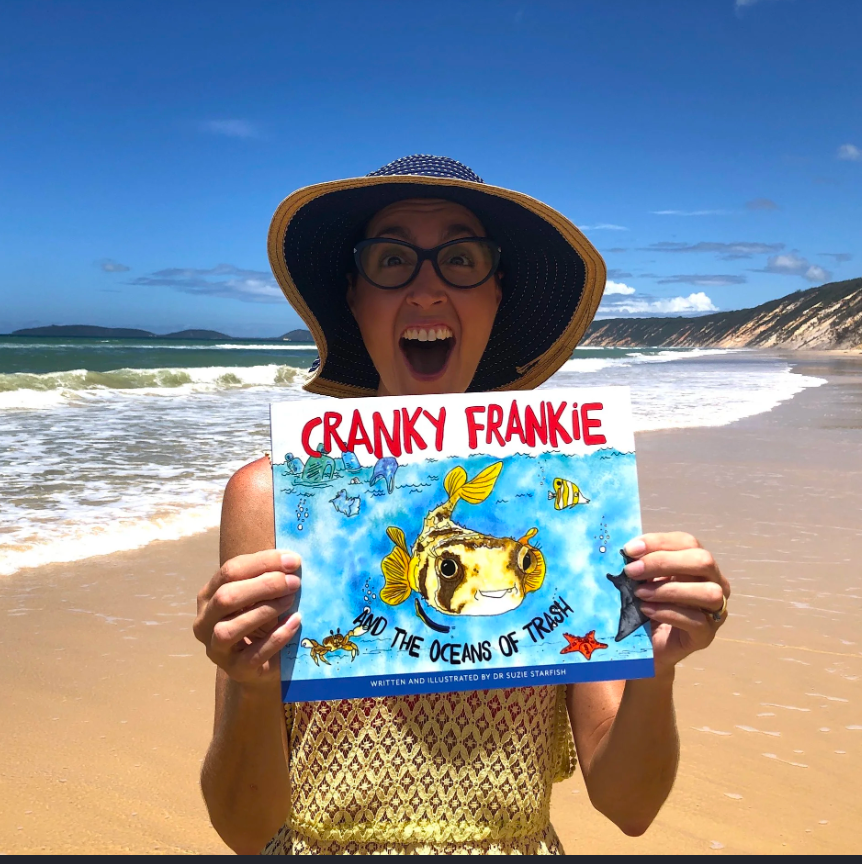
She is a marine scientist, visual artist, facilitator, author, illustrator, educator and business owner. She runs Picture Your Ideas, where she helps organisations translate complex conversations into hand-drawn visual stories. She also writes and illustrates environmentally driven children's books and visits classrooms as Dr Suzie Starfish.
Which, frankly, is a stronger personal brand than most mature businesses have. Sue nails her brand, on point and with endless good puns.
But the point is not that everyone needs a marine alter ego.
The point is that Sue did not leave science. She expanded it.
Her work takes scientific thinking and gives it a new form. She listens, interprets, synthesises and translates. She helps people see what they mean.
That is not decoration. It is not someone drawing cute pictures in the corner while the "real" work happens elsewhere.
Sue is doing serious cognitive work in visual form.
She describes standing in a workshop with paper on a whiteboard, listening to presentations and group discussions, looking for key messages, repeated themes and emotional shifts in people's voices. At the same time, she is translating those messages into words and pictures, designing the story of the day so people can see themselves in it.
"What I hear is what I draw. I never, ever, ever put anything on the page that I haven't heard. I don't try and interpret what that person said. I use their actual words."
There is a lot of integrity in that.
Her role is not to make things pretty. It is to make meaning visible.
And when you have spent years in science, policy, research or complex organisations, you know how valuable that is. People can spend months producing dense reports that nobody reads properly. They can sit in workshops full of important insights that evaporate by Monday morning. They can do years of work and still struggle to explain why it matters.
Sue's work cuts through that.
"You see it, you get it."
That is the power of visual storytelling.
Make the complex simple
At the centre of Sue's work is one clear idea: make the complex simple and the simple compelling.
That line matters because it captures something many STEM professionals underestimate.
Your value is not only in what you know. It is also in what you can help other people understand.
Sue can sit with complex science, policy, strategy or group discussion and turn it into a visual story that people can remember, share and use.
She recalls clients looking at the finished work and saying:
"That's what I do. You've translated all that and synthesized that information into one picture. You know, I've spent 25 years doing this, but you've made it simple."
That is the real work.
Not just drawing, although, seriously, imagine how fast she can draw. The fundamental value is synthesis. Communication. Translation.
Making knowledge usable.
This is one of the strongest lessons in Sue's story, because many STEM professionals are sitting on skills they do not fully value. They think the "real" expertise is the technical depth, the analysis, the data, the years of training.
And yes, that matters.
But the world also needs people who can bridge. People who can listen deeply, connect ideas, make the complex accessible and bring people into a conversation they would otherwise be locked out of.
Sue's science background did not become irrelevant when she became a visual storyteller. It became part of her edge.
She could understand the content. She could follow the complexity. She could translate without flattening the meaning.
That is why the combination worked.
The first client came before the business card
One of my favourite parts of Sue's story is how her first client arrived.
Soon after starting Picture Your Ideas, Sue received an email from a colleague at CSIRO. The colleague had attended a conference in Canada where she saw a live graphic recorder and thought, we should have that at CSIRO.
She knew Sue had a marine science background. She knew Sue did art on the side. So she contacted her.
Sue had only just started the business.
"I emailed it back and I said, you won't believe this. I've just started my own small business being a graphic recorder and yes, I cannot wait to do this with you."
That became Sue's first job, working in the Torres Strait to help draw out complex fishery science for the lobster fishery with Indigenous fishers.
There is something important hiding in that story.
People cannot connect you to opportunities if they do not know what you care about.
Sue's colleague thought of her because Sue had not hidden all the "extra" parts of herself. People knew she was a scientist. They knew she was artistic. They knew she cared about marine science and communication.
That visibility created a bridge.
Not in a loud, personal-branding way. Not in a "please enjoy my content strategy" way. Just in the very human sense that when people know what lights you up, they can remember you for the right things.
And this is fundamentally why I created my positioning sprint and thought leadership program, because the only way you can make the stars align for you is by speaking up about the things that matter to you. All the things you want to achieve or change, the impact you want to make.
You need to convey that fire and make your light memorable so people can amplify you and connect you. That's where real opportunities get shaped. Not on job boards.
That matters if you are trying to move beyond a narrow career box.
You do not need to have the whole plan ready before you start letting people see the clues.
The reality check
It would be very easy to turn Sue's story into a neat little inspiration package.
Woman leaves secure job. Starts creative business. Moves between cities and Rainbow Beach. Draws for a living. Writes children's books. Dresses as Dr Suzie Starfish. Everyone claps.
Lovely.
Also incomplete.
Sue is very clear that running a small business is not easy. It took several years, up to five, before she felt financially secure. Her husband's support was a major part of making the early years possible. The work comes in waves. She has to manage the business and be the business. She does the creative work, the admin, the marketing, the finance, the operations, the planning and the delivery.
That is the bit people often forget when they dream of a portfolio career.
Freedom still has admin. Sometimes a lot of admin.
Sue also talks about the need to keep adapting.
"Running a small business is full of risk. It is full of failure. And I just have to adapt where I can and believe in myself."
That is an honest sentence.
Not shiny. Useful.
Because designing work that fits you does not remove uncertainty. It changes your relationship with it.
You are no longer outsourcing all structure to an employer. You are building some of it yourself. That can be energising, but it can also be tiring. You need support, self-awareness, financial clarity and a willingness to keep learning.
Sue's story is not powerful because it was easy.
It is powerful because it was built with intention.
The role that fits may need to be made
There is a reason Sue's story lands so strongly.
It is not just because she has multiple hats. It is because the hats make sense together.
Marine science. Art. Education. Facilitation. Children's books. Visual storytelling. Rainbow Beach. Dr Suzie Starfish. Picture Your Ideas.
What might look scattered from the outside is deeply coherent when you understand the thread, the patchwork shows a cohesive picture.
The thread is care for the ocean, love of visual communication and the ability to make complex ideas accessible.
That is the work.
And maybe that is the question for anyone who feels boxed into a serious career.
Not, what job title should I chase next? But, what is the thread?
What keeps showing up across your life, even when you ignore it?
What do people come to you for?
What did you love before you were taught to be sensible?
What skills have you separated because one looked professional and the other looked personal?
What kind of place, pace and work makes you feel more like yourself?
Sue did not find a job description that fit all of her. She built a frame where the pieces could finally belong together.
That is not a small thing.
🔎 Actionable insight
```Take 20 minutes and draw three columns on a page.
In the first column, write the skills you are officially paid for. Keep it concrete: analysis, stakeholder engagement, writing, facilitation, teaching, strategy, research, design, commercial thinking, whatever is true for you.
In the second column, write the things you keep doing even when nobody asks you to: the topics you read about, the problems you notice, the conversations you keep having, the creative work you dismiss as "just a hobby".
In the third column, write the environments that give you energy: the people, places, formats, pace and problems that make you feel more alive.
Then look for overlaps.
Do not try to name the final job yet. That is too much pressure.
Just ask: what combination keeps asking for attention?
That is where the next version of your work may begin.
```Final reflection: where do you go next?
Sue's story is not an instruction to leave your job, start a business or become a visual storyteller.
It is an invitation to stop treating the different parts of yourself as distractions.
The scientist and the artist. The strategic thinker and the storyteller. The responsible adult and the person who wants to run towards the ocean and not answer another email. These parts may not be competing. They may be waiting to be connected.
Maybe you need to reclaim something you pushed aside because it did not look serious enough.
Maybe you need to connect skills that have been living in separate corners of your life.
Maybe you need to experiment before you make any big move.
The next step does not need to be dramatic. It could be a conversation, a small project, a course, a public post, a workshop idea, a prototype, a day of noticing what actually gives you energy.
You do not need the whole plan before you begin.
Sometimes the next version of your career is not waiting in a job ad.
Sometimes you have to build the frame before the picture makes sense.
If this resonated, it is worth asking a simple question: are you trying to find the right role, or are you trying to build one that fits you?
If you are at that point, → Start with Know thyself
Clarity is what helps you stop defaulting into roles that do not fit and start shaping something that does.
And when you are ready to make your thread visible, that is what my positioning sprint is for, turning your patchwork into a story people can remember, repeat and connect to real opportunities.
Because the stars do not align while you stay quiet.
They align when people can finally see what you have been carrying all along.