If you are a STEM professional wondering whether your career has to keep fitting the mould you were handed, this story is for you.
Academic mothers feel it in their bones…
“This isn’t right. I can’t win this game”.
This is one of these stories, where an academic mother took control of her narrative and left to carve her own path. One that fits her life, her family, her brain, without giving up the love for science.
In this article, we unpack what Dr Lorien Parker’s journey from scientist to founder of SciencePlay Kids can teach us about career reinvention, entrepreneurship, personal branding, and building work around the value only you can bring.
You will learn how to find your own patchwork, test an idea before it is perfect, rethink your business model when the maths does not work, and start positioning yourself for the opportunities you actually want.
No dramatic life-burning required.
Just honest steps, clearer thinking, and a little less waiting for permission.

Dr. Lorien Parker, founder of SciencePlay Kids.
Common Problem, different solution.
Listen to the full interview on Multiple Hats.
Lorien’s starting point is one I have heard more than I wanted to.
A great academic stepping into motherhood and realising that the system was not built for mothers and it would not redesign itself around the reality of giving birth, raising children, carrying most of the invisible load, and still trying to compete in a system built around uninterrupted output.
If you do not know what I am talking about, read Beyond the Pipelineto understand the layered model that pushes women out of academia and other STEM disciplines.
But in a nutshell, when every metric and work model is built around long hours, no career break, and no flexibility, mothers who are constrained to take time to give birth and create life, and who are then expected to take most of the parenting responsibilities, end up measured against a model that was never designed for them.
The ripple effects compound until the breaking point. And too often, women are left feeling like they can never compensate.
Lorien could have stayed and complained.
But instead, she left to build.
She took her STEM background, her lived experience, her parenting reality, her neurodivergence, and her deep belief that science education could be different, and built something with it.
That something became SciencePlay Kids.
Not overnight. Not neatly. And definitely not with a perfect five-year plan laminated on a wall.
But step by step, test by test, pivot by pivot.
Very STEM of her, really.
🧩 Find your patchwork
Lorien’s business did not come from one neat identity.
It came from a patchwork.
Scientist. Mother. Neurodivergent person. Parent of neurodivergent children. Educator. Science communicator. Feminist. Business owner.
All those pieces became part of the work.
She saw something that others were missing: science education was not accessible to all learners.
She knew this as a scientist. She knew this as a mother. She knew this as someone with ADHD and autism.
And she knew it because her own children needed something different too.
"I feel like I have fleshed out a niche in this space, and over the eight years of having SciencePlay Kids, my direction has shifted a little bit because I have found out more about myself and because I have worked out where my strengths are."
That is the bit scientist can find frustrating. You can’t always write the experiment plan. You have to live it.
Your niche is not always invented at a whiteboard. Sometimes it becomes obvious because you keep paying attention to what frustrates you, what you care about, what you are good at, and what people keep asking you for.
Annoying, I know. We all long for the lightning bolt or the incredible clarity that comes with “meditation and eating goji berries” (I don’t know, random clarity routine people rave about on the internet. I haven’t tested it, forgive me).
Turns out it is more of an itch, something you want to explore, something that feels like it could be better…
For Lorien, the patchwork became clear:
Science education was built around one way of learning. But children do not learn in one way.
“30 to 40% of a classroom can be neurodivergent in some way, including ADHD, autism, dyslexia, dysgraphia, dyscalculia, anxiety, and more.”
So why are we still pretending one format works for every child?
Sit down. Listen. Read. Write. Repeat.
Then we wonder why some children switch off.
Lorien thought she could change that. So she built something different.
🔎 Actionable insight
Ask yourself:
What do I see that others keep missing?
That question is the beginning of positioning.
Not your job title. Not your polished bio.
Not "I am passionate about making an impact", because honestly, join the queue.
The real question is:
What problem do you understand differently because of your own mix of skills, experience, frustration, values, and lived reality?
That is your patchwork. That is often where your next opportunity begins.
🧠 Learning differently is not lack of ability
One of the strongest parts of Lorien’s story is how clearly she rejects the idea that struggling in the classroom means someone lacks intelligence, ability, or potential.
It may simply mean the environment was not designed for them.
"If you didn’t thrive in the classroom and didn’t achieve the academic success, that doesn’t mean that you don’t have the knowledge. That doesn’t mean that you don’t have the skills. It just means that you weren’t given the opportunity to access those."
How many people grow up to believe they aren’t clever enough? Fish measured against monkey metrics?
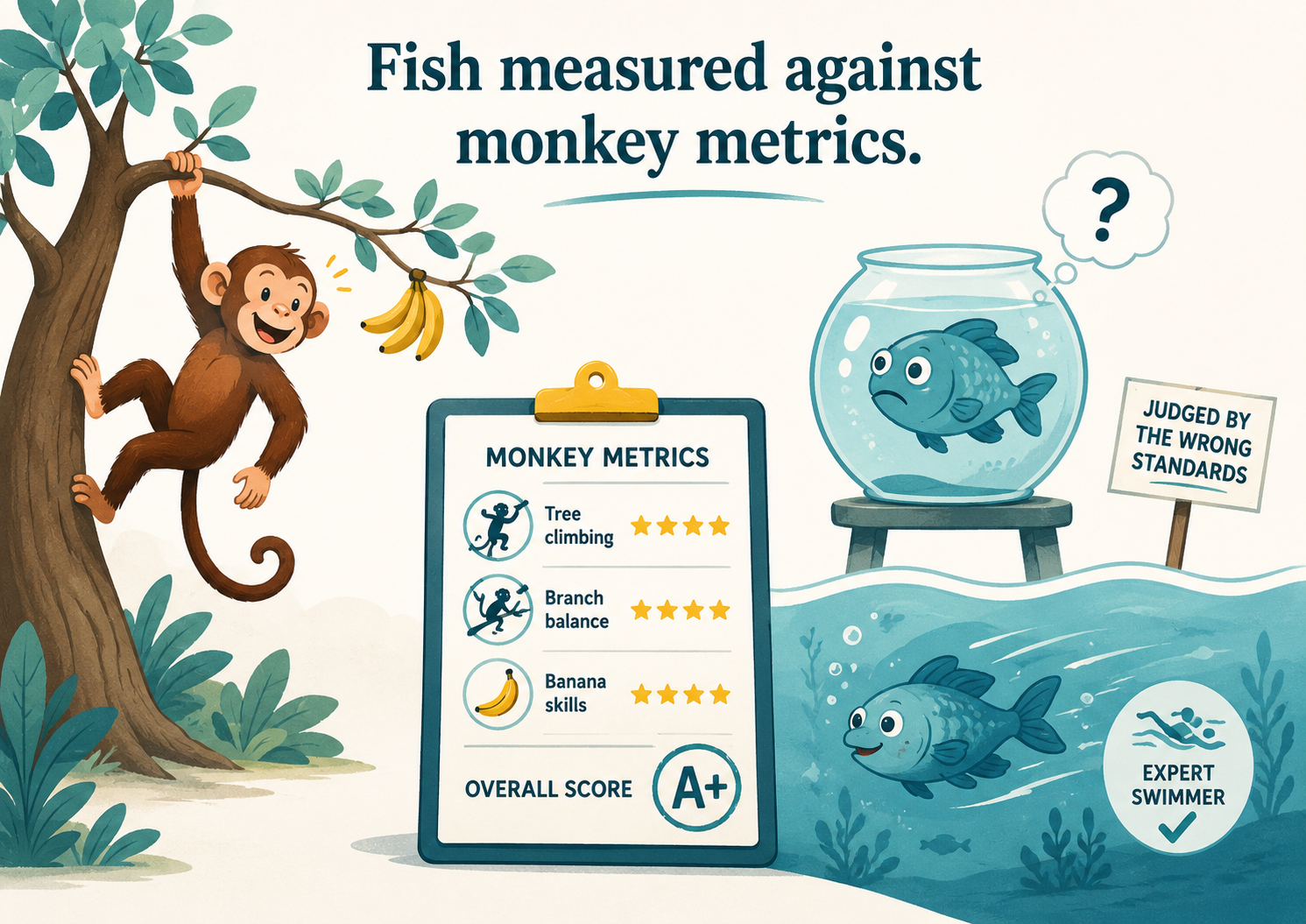
How many adults in STEM are still carrying an old story about themselves?
The one who was told they were too messy. Too slow. Too scattered. Too much. Not academic enough. Not strategic enough. Not commercial enough. Not leadership material. Not the "right fit."
Sometimes the first career pivot is not changing job. It is changing the story you keep dragging behind you.
Lorien’s work helps children experience science differently.
Not as something delivered from the front of the room, but something they can touch, test, smell, build, break, and understand in the way their brain works best.
Imagine walking into one of her workshops.
The concept is forces.
There is not one lecture. There are multiple ways in.
A child can build a car and test it on ramps. Another can read quietly in a corner. Another can draw.
Another can touch, test, talk it through, or work with an educator. They all engage with the same concept, but not in the same way.
That is the gold. Because the child learns science.
But even more importantly, the child learns:
Oh. I can learn. I just learn differently.
And for the parents watching, that can be huge too.
It changes the question from:
"Why can’t my child do this?" To: "What conditions help my child thrive?"
🔎 Actionable insight
This applies to careers too.
Stop asking only: "What am I bad at?" Ask: "What conditions help me do my best work?"
Then build from there.
That might mean different work hours, different collaborators, different ways of communicating, different types of roles, or a completely different career model. The goal is not to become a slightly less miserable version of yourself.
The goal is to understand how you work best, then design around it.
🛠 Stop fixing every weakness
One of the most practical parts of Lorien’s story is that she did not build the business by pretending she could do everything.
She understood her strengths. She also understood her gaps.
And instead of hitting her head against the wall forever, she found people who were strong where she was not.
"My business is successful now because I know what I’m good at. And I have found three or four other people that are good at the things that I’m not. And together as a team, we can do anything."
This is such an underrated career reinvention lesson. We are so often told to fix every gap.
Become more organised, more strategic, more commercial, more visible, more polished.
Become less you, basically. Exhausting!
But Lorien’s path shows something better.
Know your strengths. Know your gaps.Build around both.
For Lorien, organisation was not her natural zone. So she brought people in who could create systems, structure, and support. That did not make her less capable. It made the business stronger.
This matters for anyone trying to build something outside their 9-to-5. You do not need to become good at everything before you start. You need to know what must be done, what you can do well, and what needs support.
That is a very different thing.
🔎 Actionable insight
Do a simple skill stocktake:
✅ What do I do naturally well?
✅ What do people come to me for?
✅ What drains me every time?
✅ What keeps blocking progress?
✅ What could I outsource, partner on, automate, or simplify?
Not every gap is a personal development project.
Some gaps are a hiring brief. Some are a collaboration. Some are a system. Some are just not your job!
We love deleting unnecessary suffering from the plan.
🚀 Start before you feel ready
Lorien did not start with a perfect business model.
She started with a pilot. A small room. Some friends and their kids.
And a version of the thing.
"I asked a bunch of friends to come to a workshop, and I found a small studio and I hired that and I just started there and they came with their kids."
That was the first step. Not a rebrand. Not a 47-page business plan. Not six months of overthinking the logo while pretending it is strategy.
A room with a few people. A version of the thing.
Feedback. Repeat.
Her first pilot had around 15 parents and their children.
It was not perfect. It was harder than she expected and quite chaotic (working with children eh!)
But people came back. And that mattered.
She printed feedback forms asking:
what people would change,
whether they would come again,
what they would pay.
That is how the idea started moving from her head into the real world.
🔎 Actionable insight
If you are thinking about a career pivot, a business idea, a workshop, a speaking topic, a consulting offer, or a thought leadership direction, ask:
What is the smallest real-world test I can run?
Not the prettiest version. Not the forever version.
The smallest version that gives you feedback.
Could you:
✅ Run a free or low-cost pilot?
✅ Interview five people in the space?
✅ Write one article to test your point of view?
✅ Offer one workshop to a small group?
✅ Post one clear idea on LinkedIn and see what resonates?
✅ Ask someone what they would pay for help with?
The point is not to get it perfect but to make it real. Get out of your head and into the world.
🔁 Your first offer is rarely your final offer
Lorien started with kids’ workshops.
That made sense. She wanted to make science playful, hands-on, and accessible.
Parents loved it. Children loved it. But the business model had limits.
There is only so much parents can pay for repeat science workshops.
And when your work needs to be sensory-friendly, inclusive, and high quality, you cannot just cram 80 children into a room and call it scale ( please don’t!).
Then she moved into schools. That made sense too. It was a high leverage shift.
Schools needed it. Teachers needed support.Children benefited.
But schools also have limited budgets.
So the need was there. The value was there. But the money was not always there.
Then came the plot twist. Follow the money as always.
A parent who knew Lorien’s work also worked in an engineering group. The company wanted to contribute to science education, but they did not know how to get into schools or create a strong education program.
Lorien had the education expertise, the school relationships, the delivery model.
Bingo.
The new model was born. Corporates fund the program. Schools receive it for free. Children benefit.
The company gets to contribute in a practical way. Lorien gets a commercially viable model.
I call that the unicorn business model! Not the VC kind of unicorn. The better kind. The kind that says you can do your best work, serve under-resourced communities, and still build something financially sustainable.
How many win-win-wins is that?
🔎 Actionable insight
Your first offer may simply be the doorway.
It gives you:
✅ Proof ✅ Feedback ✅ Trust ✅ Stories ✅ Referrals ✅ Market insight ✅ Better questions ✅ Better problems to solve
Do not cling to the first model just because it was the first model.
Ask:
Who needs this?
Who values this?
Who can pay for this? Don’t skip that question. Follow the money.
Who benefits indirectly?
Who already has a budget for this problem?
That last question matters. Because sometimes the person who needs the work is not the person who can fund it.
That does not mean the idea is bad. It means the business model needs a smarter shape.
💸 Be brave, not reckless
One thing I really liked in Lorien’s story is that she did take risks. But she did not pretend risk did not exist.
She did not start with a stash of cash to play with endlessly, like most people who are not born with an emerald mine.
She and her husband made a plan. They knew what it took to run the Parker family.
They knew what they could afford on one income. They had clear timeframes.
They had clear checkpoints.
And they had one very clear rule.
"Every three or four months we had a conversation of, okay, if in six months this is not reached, then that’s when we call it quits and we find something else."
And this:
"I can use the money that comes in, but I can’t ever take the money out of the home money."
That is the grown-up version of backing yourself. Not romantic. Not reckless.
Just brave with a calculator (yes, with a spreadsheet, I know you want it).
Her milestones were practical.
Are people coming back?
Are bookings growing?
Is the model moving closer to sustainability?
Is the business generating enough money to fund its own next step?
Can we continue without draining the family?
That is the kind of risk boundary more aspiring entrepreneurs need.
Because if you accept no risk, no adjustment, and no discomfort, it is very hard to build something new.
But if you do not contain the risk, you can break yourself, your finances, and your family.
There is a sweet spot. And it will look different for everyone.
🔎 Actionable insight
Before you leap, define your version of safe risk.
Ask:
✅ What is the minimum income my household needs?
✅ What savings are off limits?
✅ What can I afford to test?
✅ How long can I test it for?
✅ What signs will tell me this has legs?
✅ What signs will tell me to pivot?
✅ What signs will tell me to stop?
This is not pessimism. This is how you give courage a container.
And honestly, courage behaves much better with boundaries.
Like toddlers. And some founders.
👀 Visibility creates opportunities you could not plan for
There is also a quiet visibility lesson in Lorien’s story.
She did not find the corporate-funded school model by sitting alone trying to perfect the plan.
The opportunity came because people had seen her work.
A parent knew what she did. A company had a need. The connection was made.
That is what visibility does when it is grounded in real work.
It helps people understand what to bring you in for.
Lorien also became known for her point of view.
She was named in the Financial Review’s 100 Women of Influence in 2018, after someone who worked closely with her put her forward.
That recognition helped her see the importance of networks, visibility, and being known for the work she was doing.
"I think it is who you surround yourself with and the people that you can connect with and word of mouth."
And this:
"Staying as visible as possible and continuing to be seen to be doing the things that really me doing and being vocal about it."
Keep being seen doing the work that matters to you.
Keep saying what you stand for.
Keep showing people what you are building.
Because people cannot connect the dots for you if you have not shown them the dots.
Frankly, they don’t care. Your job is to make them care.
🔎 Actionable insight
If you are a STEM professional thinking about a career change, career pivot, entrepreneurship, or thought leadership, do not wait until everything is fully formed before you speak.
Start showing the thread.
Talk about:
✅ The problems you care about
✅ The patterns you are noticing
✅ The work you want to do more of
✅ The lessons from your experiments
✅ The people you want to serve
✅ The ideas you want to be known for
This is how opportunities start recognising you. Not because you shouted the loudest.
But because you became easier to understand, remember, and refer.
🎯 The real career pivot starts before the job title changes
This is why I keep coming back to positioning. Because before Lorien had the fully formed business model, she had a clear point of view.
Science should be accessible for all learners. Neurodivergence is not a deficit.
Different brains need different ways in and education should not punish children for learning differently.
That clarity made it easier for people to understand her work, remember her, refer her, and eventually bring her opportunities.
And that is the bit many STEM professionals skip.
They wait until the new role, business, offer, or title is fully formed before they start talking about it.
But often, the talking is what helps the opportunity take shape.
Lorien’s story shows that your positioning is not a polished sentence you write at the end. It is the thread you keep making clearer as you go.
It is how you explain:
This is what I see.
This is why it matters.
This is what I know how to do.
This is who I help.
This is the kind of work I want to be known for.
That matters whether you want to build a business, move into leadership, become a consultant, create a portfolio career, or simply stop being boxed into work that no longer fits.
And if you are sitting there thinking:
"I know I bring value, but I cannot explain it clearly yet."
That is exactly the work I do in my Positioning Sprint.
We take the messy pile of skills, experience, values, half-formed ambition, and "I swear there is something here" energy, and turn it into a clear positioning statement you can actually use to connect to and create the kind of opportunities you want next.
🧭 Final reflections: where to next?
Lorien’s story is not a neat little "follow your passion" postcard and I doubt that your story would fit in that box either.
It is a story about noticing what is broken, finding the part only you can deliver, testing it in the real world, changing the model when the maths does not work, and building enough support around you to keep going.
That is what career reinvention in STEM often looks like.
Not one dramatic leap where you burn it all. More like a series of honest adjustments.
What do I care about?
What do I know? What have i lived through that gives me a different lens?
What drama or trauma do i carry that I can transform to build something?
What do I see that others miss?
What can I test first?
What risk can I afford?
What story do I need to start telling so the right people can see the value I bring?
That is your patchwork.
Want help finding your own patchwork?
If you are a STEM professional and you know you are ready for a career pivot, a new direction, or a clearer personal brand, but you cannot quite explain what you bring to the table yet, I can help.
My Positioning Sprint is designed to help you connect the dots between your skills, experience, values, and ambition, so you can speak about your value clearly and start creating better opportunities for yourself.
No fluffy personal branding exercise but in depth conversation, with interview techniques, to get the gold out of your head.
Just clear positioning you can use in conversations, LinkedIn, networking, interviews, offers, and the next chapter of your career.
Book a free clarity call and we can map your next best step together.
