You Are Not One Thing: Making Room for the Parts Your STEM Career Left Behind
Your STEM career may be meaningful, valuable and hard-won. But it may still be only one part of you.
What happens when the serious, credible professional becomes the only version of you allowed in the room?
Through the stories of Dr Anupama Hariharan, Dr Sue Pillans and Dr Chloe Lim, we explore three ways to reclaim the parts of ourselves that have been hidden, underused or not yet discovered.
Get ready to unleash your other self.
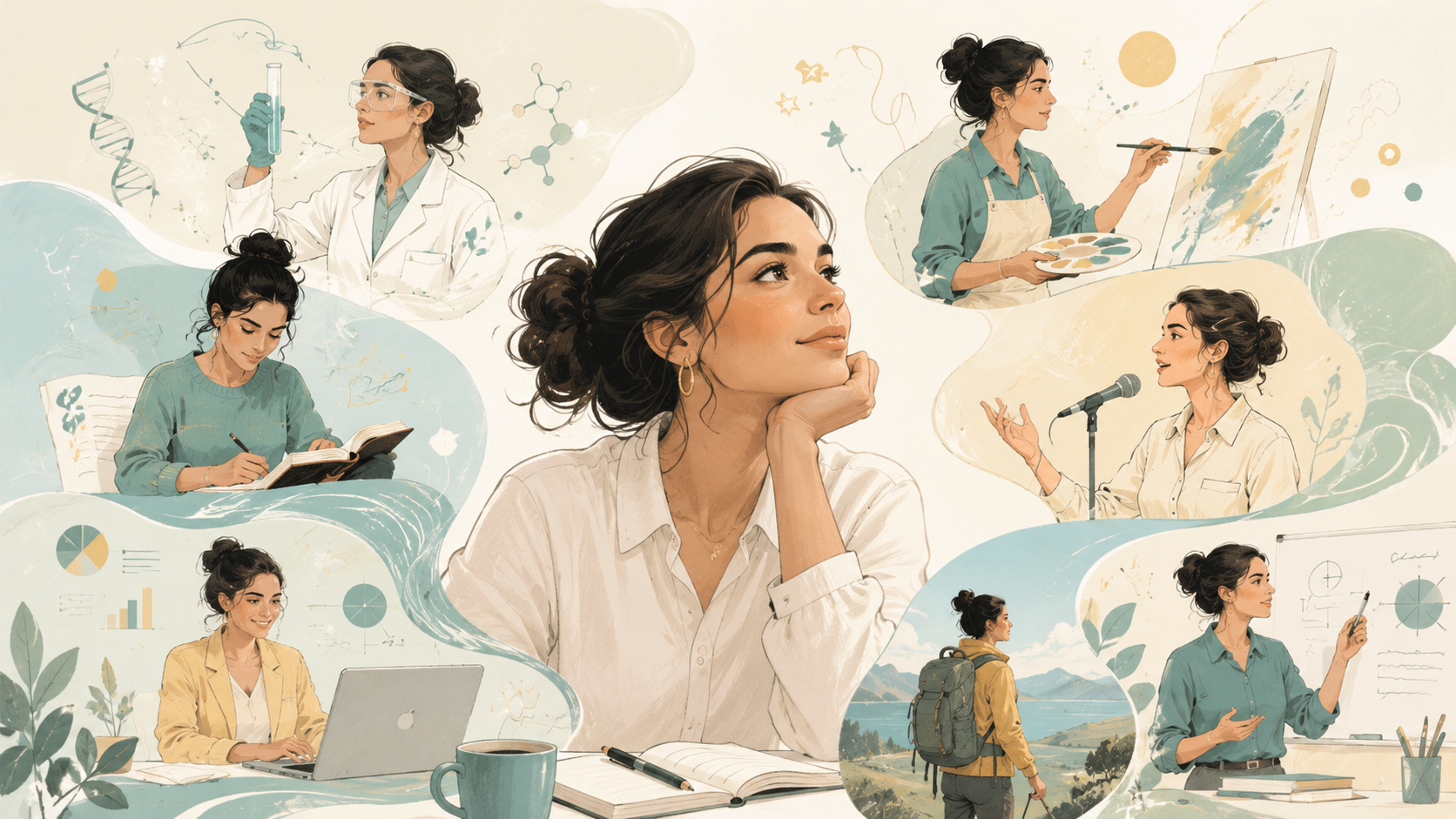
I contain multitude
You contain Multitudes.
Listen to the full episode on Multiple Hats.
🧭 The serious career box
“You can be anything.”
It sounds generous, doesn’t it?
But often, when adults say this to a child, what they really mean is: you can be anything sensible. Anything respectable. Anything that pays the bills.
And if you were good at science, mathematics or problem-solving, the path may have appeared especially clear: become a scientist, doctor, engineer, researcher or clinician. Find the serious path. Earn the degree. Build the credible career.
Find your box.
There is nothing inherently wrong with that box. A career in STEM can be fascinating, meaningful and deeply rewarding. The problem begins when it becomes the only version of you allowed in the room.
What happens to the writer? The artist? The speaker, performer, advocate, teacher or founder? What happens to the person who wants to build, make, explore or express something that has nothing to do with their official job title?
🪞 “I contain multitudes”
“I am large, I contain multitudes.” — Walt Whitman
We are not flat, fixed or perfectly coherent identities. We are made of many parts: the professional self, the creative self, the ambitious self, the responsible self, the playful self, the frightened self, the caretaker, the rebel, the person who wants approval—and the person who wants to run towards the ocean and never answer another email again.
Some of these parts are rewarded early. They receive praise, qualifications and promotions. Others are treated as inconvenient, impractical or unserious and quietly pushed aside.
For STEM professionals, the analytical self is often heavily rewarded. It becomes highly trained, trusted and visible. But usefulness is not the same thing as wholeness.
A successful professional identity can still leave other parts of us hungry.
✍️ The self that was always there: Dr Anupama Hariharan
Dr Anupama Hariharan began her professional life as a dentist in India. She came from a family of doctors and engineers, where the expectations around a good career were clear. Dentistry was respected, serious and secure.
But Anu had another part of herself that had been present since childhood.
“My real pull was always into literature. I think from age seven, probably, I was quite interested in writing. I used to spend a lot of my time writing—stories about animals, nature, even conversations between a brinjal and a tomato. I think, right from childhood, I had that capacity to focus grief into something more creative.”
She wrote stories and poems. She used creativity to process grief and even received recognition for her poetry while she was still at school. The talent was there. What was missing was an environment that made authorship feel like a legitimate possibility.
“Having validation, skill sets and talent is one thing, but having the right environment to nurture that is quite another. At that time, your career options were pretty much set. The mindset wasn’t really there that she can become an author and become a big author. We were taught to limit our belief systems. For all practical purposes, I moved into dentistry because that seemed like a natural step for me, and that put my whole writing career on the back burner.”
So she followed the path that made sense within the world around her. She studied dentistry and later moved into clinical research, where she built a substantial professional career.
The writer did not vanish. She remained in old notebooks, half-remembered poems and the quiet background of Anu’s life.
Years later, after a nudge from her mother and an online poetry challenge, Anu finally gave the writer a proper chance. She completed a 21-day challenge in eight days. The poems were published, the work received an award, and she kept writing.
“My mum suddenly looked back at me and said, ‘Why don’t you write? I think you will do well.’ I didn’t pay much attention at the time. After she passed away, I sat in her chair and that conversation came back to me. Then I entered a poetry challenge using poems I had already written. We published the book, it received an award, and I thought, maybe this could become a career pathway tomorrow—my hobby. I started writing, and I’ve never stopped after that.”
Within roughly a year, she had written six books.
She did not suddenly become a writer. She allowed the writer who had always been there to step forward.
Sometimes the next part of you does not need to be invented. Sometimes it needs to be acknowledged.
🎧 Listen to Dr Anupama Hariharan’s full Multiple Hats interview
🎨 The bridge between worlds: Dr Sue Pillans
Dr Sue Pillans offers a different pattern. Sue is a marine scientist who has worked across government, universities and research organisations. She is also an artist, author, illustrator, educator and visual storyteller.
Her story is not about leaving science to become an artist, as though these were two separate planets. It is about designing a bridge between them.
“I remember drawing a lot, and I still have some of the pictures. But once I went to high school, I was encouraged to do the maths and the sciences so that I could get into university and get a good job, which is what you did back then. Once I got into my PhD, I really needed an outlet, so I found a local watercolour class and turned up once a week for about five or six years.”
During her PhD, Sue needed a creative outlet and began attending weekly watercolour classes. For years, the women in the class listened to her stories about marine life, fieldwork, sharks, crabs and ocean science.
Then her art teacher asked a powerful question:
“Why don’t you write children’s books about the science of the oceans and illustrate them? You watercolour. You love science and you love the ocean. Why don’t you combine that all together?”
The question did not ask Sue to choose. It asked her to combine.
Her children’s books became one expression of that combination. Graphic recording became another. Sue now listens to complex discussions in conferences and workshops, identifies the themes and emotional shifts, and translates them live into visual maps.
“When I’m working with clients who have very complicated stories—data or scientific stories they may have been working on for 25 years—I translate and synthesise that information into words and pictures. They look at it and say, ‘That’s what I do. I’ve spent 25 years doing this, but you’ve made it simple.’ Even though it was complex, it is simplified so that a greater audience can digest that information. When you see it, you get it.”
Her scientific and artistic selves are not competing. They are collaborating. Her research background helps her understand systems and technical detail. Her artistic ability helps her make that meaning visible.
Sue’s story asks a different question from Anu’s: not “Which hidden identity has been waiting to emerge?” but “What could the different parts of me create together?”
You may not need to choose between your worlds. You may need to design the bridge between them.
🎧 Listen to Dr Sue Pillans’ full Multiple Hats interview
🎈 The self you discover by trying: Dr Chloe Lim
Not every underused part of you has been waiting since childhood. Sometimes there is no old notebook, dormant dream or secret calling.
Sometimes a new part of you only appears because you try something.
Dr Chloe Lim has a PhD in medical science and spent years in epigenetic research before moving into regulatory science. Her career also includes balloon artistry, children’s education, science communication, entrepreneurship, podcasting and mentoring.
None of it began with a five-year plan. It began at a church community event. Someone needed to make balloon animals. Nobody volunteered.
“I was asked to twist balloons at a community church event, and no one put their hands up. So I thought, ‘Maybe I could give this a go.’ I went onto YouTube, looked for videos on how to make a balloon dog, made my first one and said, ‘Wow, this is actually quite fun.’ Then I tried a few more designs, and before you knew it, I was hooked.”
Chloe went onto YouTube, learned how to make a balloon dog and discovered that she enjoyed it. She practised. She became good at it. Then she connected the balloons with a children’s book she had written about DNA and with her scientific knowledge.
“When I started Giggly Wiggly Balloons, I also published a children’s book called What Makes You Unique? It was a book about DNA. I was already developing storytelling shows with balloons, and I thought, ‘Maybe I can do something with my book and balloons and science altogether.’ So I created a science show, and that became what I now call the Twisty Science Show.”
That experiment became Twisty Science, where Chloe uses balloon creations and storytelling to explain scientific concepts to children and families.
“It’s interesting when you try something new, where it takes you. Balloon twisting has taken me onto lots of different adventures and interesting projects. I think it’s a matter of being willing to fail. If it doesn’t work out, it doesn’t work out—but you never know until you try.”
She did not think her way into a fuller identity. She tried her way there.
🎧 Listen to Dr Chloe Lim’s full Multiple Hats interview
🔀 Three ways to make more room for yourself
These three stories show three different patterns:
Anu: the self that was always there.
Sue: the bridge between worlds.
Chloe: the self discovered by trying.
When we feel boxed in, we often ask: “What job should I do next?” It is a reasonable question, but it may be too narrow.
A better question might be: Which part of me is asking for more room?
🔎 Actionable insight
Ask yourself which of these three patterns best describes you:
1. It has always been there.
Reopen the notebook, folder, draft or idea you keep returning to.
2. Two parts of you need a bridge.
Ask how your professional expertise and creative interests could work on the same problem.
3. You may only discover it by trying.
Run a small experiment: a class, conversation, weekend project, prototype or tiny public test.
Choose one underused part of yourself and give it one concrete act of permission this week.
🌱 Give one part of you permission
Write the page. Book the class. Make the thing. Send the message. Record the idea. Pull out the old poem. Sketch the concept. Pitch the talk.
Spend one hour with that part of yourself and do not ask it to justify its existence.
Just give it room.
Maybe you do not need to become someone completely different. Maybe you simply need to let more of yourself into the room.
🎙️ Explore more stories on Multiple Hats, the podcast for STEM professionals who feel boxed in and are ready to explore what else they could build, become or bring into the world.
🧭 Final reflections: where to next?
Final reflection: where do you go next?
The goal is not to discover a perfect second identity overnight. It is to notice what keeps asking for your attention.
Maybe it is something you have always known about yourself but kept postponing. Maybe it is a combination of skills that has never had a clear name.Maybe it is a new curiosity that only needs a small experiment.
Before you leave this page, ask yourself:
Which part of me has been overused because it was rewarded?
Which part of me has been underused because it did not look practical?
What keeps catching my attention, even when I try to dismiss it?
Do I need to reclaim something, connect two parts of myself, or try something new?
What is one small action I can take this week without needing to justify where it will lead?
You do not need the full plan.You only need the next honest experiment.
That might be one hour, one conversation, one class, one draft, one sketch, one application or one message.
The point is not to prove that this new part of you can become a career.The point is to stop denying it room before you know what it could become.
Want help finding your own patchwork?
If you are a STEM professional and you know you are ready for a career pivot, a new direction, or a clearer personal brand, but you cannot quite explain what you bring to the table yet, I can help.
My Positioning Sprint is designed to help you connect the dots between your skills, experience, values, and ambition, so you can speak about your value clearly and start creating better opportunities for yourself.
No fluffy personal branding exercise but in depth conversation, with interview techniques, to get the gold out of your head.
Just clear positioning you can use in conversations, LinkedIn, networking, interviews, offers, and the next chapter of your career.
Book a free clarity call and we can map your next best step together.
