More than “just” a scientist - The Skills That Transfer Far Beyond the Lab
"I am just a scientist."
It sounds modest. It is also usually wrong.
Scientists often struggle to describe what they can do beyond their technical field. Yet years in STEM train you to examine evidence, navigate uncertainty, communicate complex ideas and solve difficult problems. Those capabilities travel much further than most scientists realise.
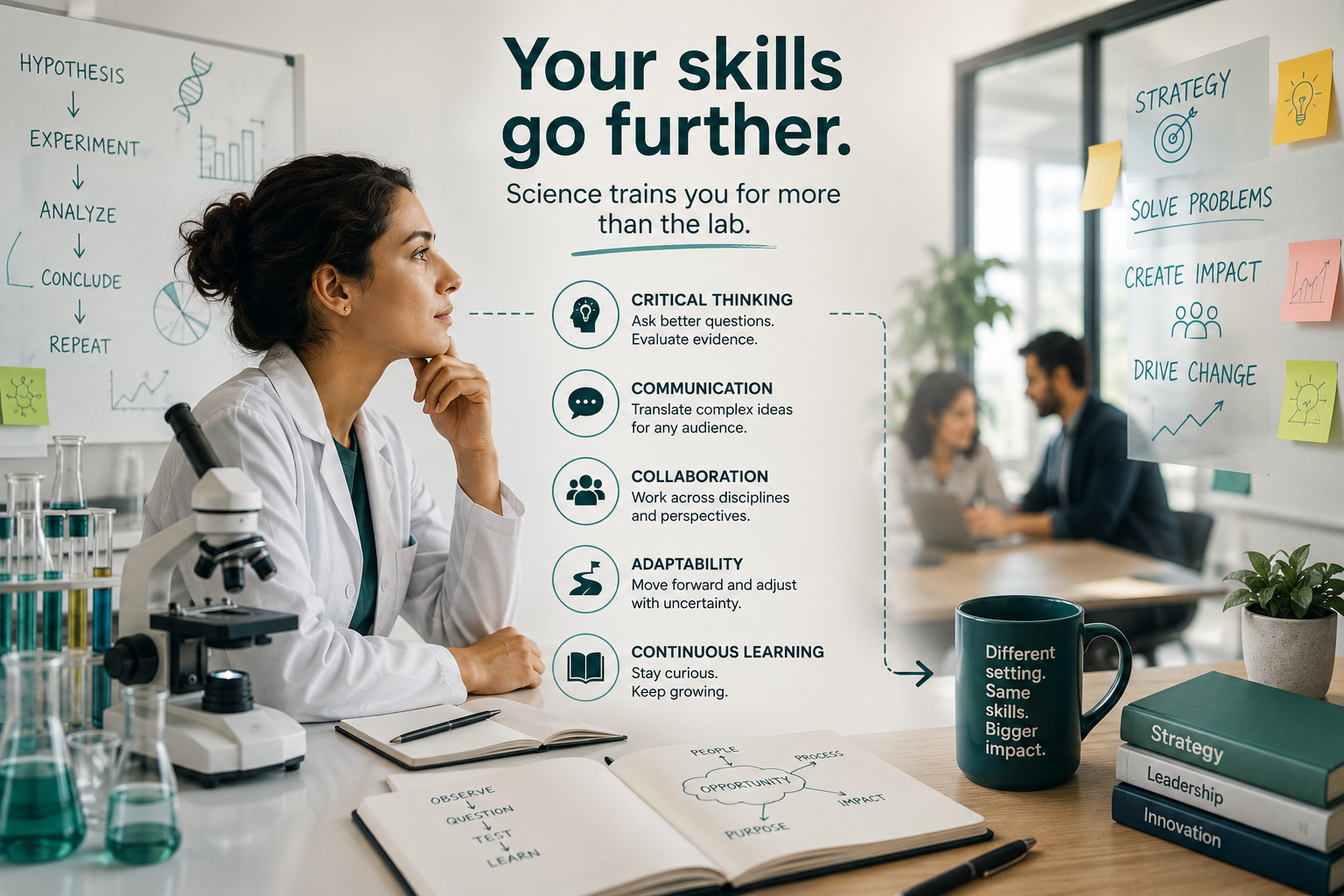
Skills that go beyond the lab
Skills that go beyond the lab
Listen to the firechat monthly episodes with a new perspective from a new STEM founder each month
They look at a job description, business idea or unfamiliar industry and immediately focus on the knowledge they do not have.
No marketing degree.
No formal business training.
No experience in that exact sector.
Therefore, no obvious fit.
But technical knowledge is only one part of what years in STEM have trained you to do.
Across the Multiple Hats Fire Chats, I ask people who have built careers beyond their original training one recurring question:
Which scientific skills transferred with you?
Their answers are rarely about a particular assay, instrument or technical method.
They talk about how scientists think, communicate, collaborate and solve problems.
The myth: My skills only matter in my technical field
Your technical expertise may be specialised.
Your ability to examine evidence, find patterns, test assumptions and work through uncertainty is not.
The problem is that we often confuse the context in which we developed a skill with the skill itself.
You may have developed critical thinking while reviewing experimental data.
That does not mean critical thinking only matters in a laboratory.
You may have learned to communicate while presenting research.
That does not mean communication only matters at scientific conferences.
You may have built collaboration skills while working across research teams.
That does not mean those skills disappear when you move into business, policy, consulting, education or entrepreneurship.
The setting changes.
The underlying capability remains.
1. Critical thinking is valuable almost everywhere
Rachel Service, founder and CEO of Happiness Concierge, sees strategic and critical thinking as skills many organisations actively need.
"Strategic and critical thinking, analysis, and the ability to communicate a very complicated message succinctly. Scientists are very good at those skills, and workplaces really want them."
Scientific training teaches you to ask:
- What evidence supports this?
- What assumptions are we making?
- What else could explain the result?
- What information is missing?
- What happens if we are wrong?
Those questions matter whether you are assessing an experiment, a business strategy, a customer problem or a new opportunity.
Many workplaces are not short of opinions.
They are short of people who can separate a plausible idea from one supported by evidence.
That is a scientific skill.
Rachel also points to something we often overlook: staying calm while dealing with complexity.
Scientists regularly work with incomplete information, unexpected results and plans that do not behave as expected.
Or, as science calls it, Tuesday.
The ability to pause, examine what is happening and respond logically has value far beyond the lab.
2. Communication is not separate from the science
ShanShan Wang, founder of Roam Technologies, described communication as one of the most underrated transferable skills.
"What is underrated is communication. Being able to articulate the problem in one sentence, the solution, the market and even the technical side."
That can be uncomfortable for scientists.
We are trained to preserve complexity, qualify statements and include the caveats.
Those are useful habits, until they stop anyone else from understanding what we are saying.
Outside your immediate technical circle, your value is not measured by how much information you can provide.
It is measured by whether people can understand the problem, make a decision or take useful action because of what you explained.
Clear communication does not require you to make the science simplistic.
It requires you to do the difficult thinking first, then identify what matters most.
Can you explain:
- the problem without giving a ten-minute history lesson?
- why it matters to someone outside your field?
- what decision needs to be made?
- what action should happen next?
That is not dumbing down your expertise.
It is making your expertise usable.
3. Collaboration means looking beyond your own discipline
Shilpa Agarwal, founder of ClinEQ Training and Chapter One Publishers, pointed to human connection, collaboration and an open mindset.
"Be open to meeting people and do not dismiss those who are not from a science background. Be open to collaboration and networking."
She admitted that earlier in her career, she assumed she would have little in common with someone from a field such as accounting because they did not speak the language of clinical research.
It is an understandable instinct.
It is also limiting.
Difficult problems rarely sit neatly inside one discipline.
A scientist may understand the mechanism.
A clinician may understand the workflow.
A designer may understand how people interact with the solution.
A commercial expert may understand whether anyone will pay for it.
A patient may identify the problem everyone else has missed.
Being technically strong is useful.
Assuming technical knowledge is the only knowledge that matters is not.
One of the most valuable skills you can carry from science is the ability to work with different forms of expertise without needing to become the expert in everything.
4. Scientists know how to move without perfect certainty
Another transferable strength is easy to overlook because it feels normal when you have spent years in science.
You know how to keep moving when the answer is incomplete.
You form a hypothesis.
You gather the available evidence.
You test something.
You review what happened.
Then you adjust.
That is not very different from building a business, shaping a new role or testing a career direction.
The information will never be complete.
The difference is that outside the lab, the experiment may be:
- a conversation with someone in another field
- a small workshop
- a pilot service
- a job application
- a speaking opportunity
- a side project
- one afternoon spent testing an idea
Scientists sometimes think they need to become less scientific to move into something new.
In reality, they may need to apply the scientific method more deliberately to their own careers.
The real gap is often translation
Your skills probably transfer.
Your description of them may not.
Consider the difference.
"I analysed experimental data."
This tells someone what you did.
```"I used complex and incomplete evidence to identify risks and support decisions."
This tells them what capability you bring.
```Another example:
"I presented at scientific conferences."
Becomes:
```"I translated complex technical findings for different audiences."
And:
"I coordinated research collaborators."
Becomes:
"I aligned specialists with different priorities around a shared outcome."
```You do not need to exaggerate your experience.
You need to stop describing it only in the language of the environment where you developed it.
🔎 Actionable insight: Translate one part of your experience
```Choose one responsibility from your current or previous role.
Then answer four questions:
What did I actually do?
Avoid using your job title as the answer.
What problem did it solve?
Think about what became clearer, faster, safer or more effective because of your work.
What skill did that require?
Look beyond the technical task.
Where else would that skill matter?
Consider other functions, sectors, roles or types of work.
Example:
What I did: Investigated inconsistent study data.
Problem solved: The team could not make a reliable decision because the information conflicted.
Transferable skill: Identifying patterns, testing explanations and making sense of incomplete evidence.
Where else it matters: Strategy, consulting, operations, product development, investment, policy and leadership.
```That is how you begin to see your experience differently.
Not as a list of tasks tied to one job.
As evidence of capabilities that can travel.
Final reflection: You are more than your technical label
Your scientific background matters.
But it is not the boundary of what you can contribute.
It trained you to ask better questions.
To examine evidence.
To work through ambiguity.
To explain difficult ideas.
To collaborate across disciplines.
To learn what you do not yet know.
Those skills do not stop being useful when you leave the lab, change industries, start a business or build work that did not exist before.
The next step is not to discard your scientific identity.
It is to recognise how much more sits inside it.
Hear the Fire Chats
Listen to the conversations behind these insights:
Listen to the Fire Chat with Rachel Service, founder of Happiness Concierge →
Listen to the Fire Chat with ShanShan Wang, founder of Roam Technologies →
This article is part of the Multiple Hats Fire Chat series, challenging the beliefs that hold STEM professionals back. New guest perspectives will be added as the series grows.
🧭 Final reflections: where to next?
Final reflection: where do you go next?
You do not need to know your entire next career move.
You do need to notice which part of you is asking for more room.
Is it the part that wants to solve bigger problems?
The part that wants more influence?
The part that wants to create, teach, advise, lead or build something of your own?
Your next step may not be a dramatic exit.
It may be a small act of translation.
Reclaim one capability you have been dismissing.
Connect with someone working in a space that interests you.
Experiment with one small project before deciding what it means.
You are not required to have the full plan before you move.
You only need enough clarity for the next useful step.
Your scientific identity is not the box. It is one of the tools you carry with you.
Want help finding your own patchwork?
If you are a STEM professional and you know you are ready for a career pivot, a new direction, or a clearer personal brand, but you cannot quite explain what you bring to the table yet, I can help.
My Positioning Sprint is designed to help you connect the dots between your skills, experience, values, and ambition, so you can speak about your value clearly and start creating better opportunities for yourself.
No fluffy personal branding exercise but in depth conversation, with interview techniques, to get the gold out of your head.
Just clear positioning you can use in conversations, LinkedIn, networking, interviews, offers, and the next chapter of your career.
Book a free clarity call and we can map your next best step together.
